
The Transformation of Singapore’s North-East: From Residential Heartland to a Future-Ready Employment Corridor
Explore how Sengkang West, Punggol Digital District and Seletar Aerospace Park are transforming Singapore’s North-East into a major live-work employment corridor.
Singapore’s North-East has traditionally been recognised for its large residential towns, waterfront neighbourhoods and family-oriented communities.
Today, that identity is changing. The region is gradually developing into a more complete live-work economic corridor, with new employment centres emerging alongside established residential towns such as Sengkang, Punggol, Hougang and Serangoon.
Under the URA Master Plan 2025, the transformation is increasingly visible through three important growth areas: Punggol Digital District, Sengkang West and Seletar. URA specifically identifies these developments as part of the effort to provide residents in the North-East with more employment opportunities closer to home.
For businesses and industrial occupiers, this transformation deserves attention.
The North-East is no longer simply a place where people live. Increasingly, it is also becoming a place where people work, innovate, manufacture and build businesses.
From Residential Region to Live-Work Economy
One of the fundamental ideas behind Singapore’s decentralisation strategy is straightforward: employment opportunities should not be concentrated only around the Central Business District or Singapore’s traditional industrial belts.
Instead, new business and employment nodes are being developed closer to where people live.
URA states that this strategy will create a pipeline of jobs closer to homes in areas including Ang Mo Kio, Hougang, Punggol, Sengkang and Serangoon.
This is particularly relevant to the North-East because of the region’s substantial residential population.
According to HDB statistics as at March 2025, approximately:
224,510 residents lived in HDB flats in Sengkang;
177,470 residents lived in HDB flats in Punggol; and
162,900 residents lived in HDB flats in Hougang.
Together, these three towns alone account for approximately 564,880 HDB residents.
For companies considering where to locate their operations, population is more than a demographic statistic.
It represents a potential workforce catchment.
Manufacturing companies, engineering firms, warehouse operators and other industrial businesses require technicians, operators, engineers, administrative employees, logistics staff and supporting personnel.
Being located closer to major residential towns can therefore become a practical business consideration.
A factory may have excellent specifications, but ultimately businesses still require people to operate it.
Sengkang West: A New Chapter in the North-East
Among the more significant changes taking place is the emergence of Sengkang West as an industrial employment area. This is no longer simply an anticipated future direction.
URA’s Master Plan 2025 material specifically identifies a Future Sengkang West Industrial Estate & Park, placing industrial development directly within the wider transformation plans for the North-East.
The Government has also begun releasing industrial land in Sengkang West.
In June 2025, JTC launched a 2.32-hectare Business 2 industrial site at Sengkang West through the Industrial Government Land Sales programme. The site carries a gross plot ratio of 2.5 and a 33-year land tenure. Following a competitive tender that attracted four bids, the site was awarded to Soilbuild Group Holdings Ltd in October 2025 for approximately S$156.1 million.
The development of this site marks an important milestone for Sengkang West.
Rather than remaining primarily on the edge of a residential catchment, the area is beginning to establish a clearer industrial identity within Singapore’s North-East.
Sengkang Connection and the Emerging Industrial Landscape
It is against this wider backdrop that Sengkang Connection is being developed.
Developed by Soilbuild as a modern B2 ramp-up industrial project, Sengkang Connection introduces new industrial premises into an area surrounded by some of Singapore’s largest residential communities.
From an industrial real estate perspective, this creates an interesting location proposition.
The project is not situated within one of Singapore’s traditional industrial strongholds such as Tuas, Jurong, Woodlands or Sungei Kadut.
Instead, it forms part of an emerging industrial node within the North-East itself.
That matters because the surrounding region already possesses three important ingredients:
a large residential population, expanding employment centres and established industry clusters.
The combination helps explain why Sengkang West should be considered in the broader context of North-East Singapore’s transformation rather than viewed simply as another standalone industrial estate.
Punggol Digital District: 28,000 Jobs in the Digital Economy
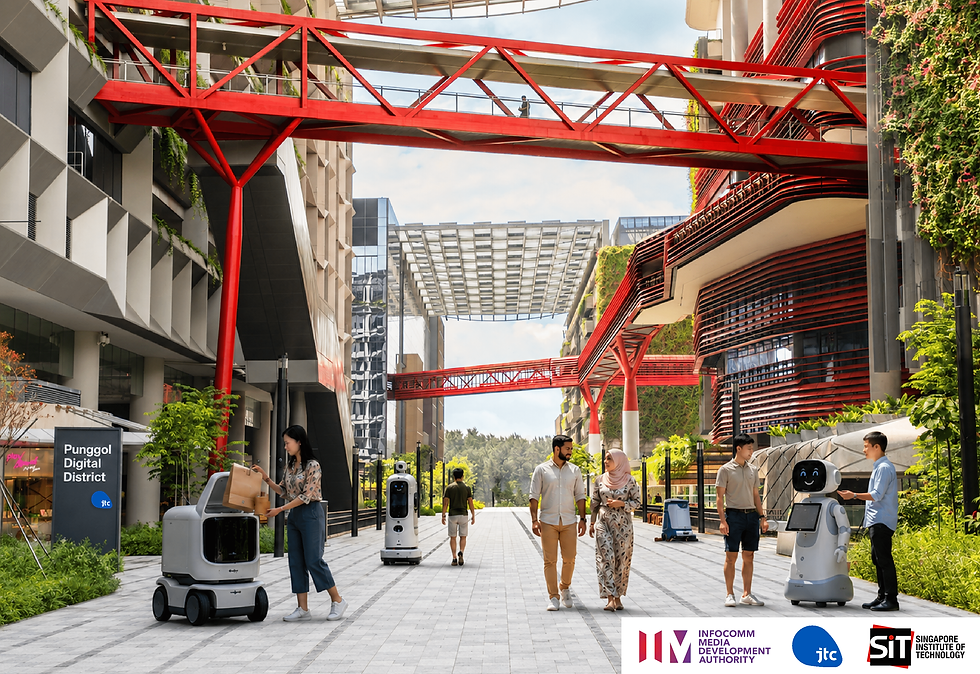
Perhaps the most visible example of the North-East’s transformation is Punggol Digital District, located nearby. Master planned and developed by JTC, Punggol Digital District is a 50-hectare business park designed around industries including artificial intelligence, cybersecurity, robotics, fintech and other digital technologies.
When fully developed, the district is expected to accommodate approximately 28,000 jobs.
The district is also integrated with the Singapore Institute of Technology's Punggol campus, which is expected to accommodate approximately:
12,000 students and more than 500 faculty members and professional officers.
This creates an unusual concentration of business, education, research and talent within the same district.
For the North-East, the significance extends beyond Punggol itself.
PDD represents the creation of a substantial new employment population within a region historically associated primarily with residential growth.
It also strengthens the availability of technology and engineering talent across the wider North-East employment ecosystem.
Seletar Aerospace Park: An Established Advanced Industrial Cluster

On the other side of Sengkang sits another important employment centre: Seletar Aerospace Park.
Unlike Punggol Digital District, Seletar is already an established industrial cluster. According to JTC, Seletar Aerospace Park is home to more than 80 multinational and local companies and supports a workforce of more than 6,000 aerospace professionals.
Activities within the estate range from engine manufacturing and maintenance, repair and overhaul to research, development, training and other aerospace-related services. The concentration of major aerospace and engineering companies creates another important pool of skilled personnel within the northern and north-eastern part of Singapore.
When considered together, a clearer picture begins to emerge:
Punggol contributes digital and technology employment.
Seletar contributes aerospace, engineering and advanced manufacturing capabilities.
Sengkang West introduces another layer of modern B2 industrial activity.
For businesses operating from Sengkang West, this creates proximity to both a large residential workforce catchment and specialised employment clusters. This does not automatically guarantee recruitment success for every company.
However, from a location-planning perspective, the availability of a substantial surrounding population can be an important advantage when compared with more remote industrial locations.
These different employment nodes are not identical, but collectively they contribute towards a more diversified economic base for North-East Singapore.
Infrastructure Is Following the Growth
Transport infrastructure is also evolving alongside the North-East’s employment growth.
One important milestone was the opening of Punggol Coast MRT station on 10 December 2024.
Located within Punggol Digital District, the North East Line station provides direct rail connectivity to the JTC Business Park and SIT campus.
The opening of Punggol Coast station is significant because it illustrates how employment development and transport planning are being coordinated. Rather than creating isolated business districts, Singapore’s planning approach increasingly integrates workplaces with housing, public transport and community infrastructure. This model is particularly visible across the North-East.
The Next Phase of Singapore’s North-East
Singapore’s North-East has changed significantly over the past several decades, and its next phase appears increasingly focused on creating a more complete environment for living, working and doing business.
Punggol Digital District introduces technology and innovation.
Seletar Aerospace Park provides an established advanced industrial ecosystem.
Sengkang West is beginning to develop its own industrial identity.
And surrounding all three are some of Singapore’s largest residential communities.
This combination of population, employment, talent and industrial development is reshaping the economic role of the North-East.
For companies evaluating future industrial locations, the important question may therefore no longer be simply:
“Why locate a factory in Sengkang?”
A better question may be:
“What happens when a new generation of industrial space is introduced beside one of Singapore’s largest concentrations of residents, talent and emerging employment nodes?”
That is the bigger story behind the transformation of Singapore’s North-East.
Looking for Industrial Space at North-East Region?
Sengkang Connection represents a compelling opportunity for businesses planning long-term operations in Singapore’s north-east industrial zone.
This Project might be one of the most strategic factory purchases available right now.
Get more infos or Book a Visit
Keen to see unit layouts, pricing or check if it fits your biz needs?
👉 Kindly contact us to get more details or to arrange a private walkthrough—no obligations.
Comments